
About the Turntable
|
ONEDOF (ONE DEGREE OF FREEDOM) TURNTABLE is the most sensitive engineering instrument for reproducing vinyl records. Designed, manufactured and hand assembled with exact precision, one unique piece of art at a time by Aleks Bakman, a decorated by NASA aerospace engineer, proprietor of Onedof LLC in Denver, Colorado, USA. |
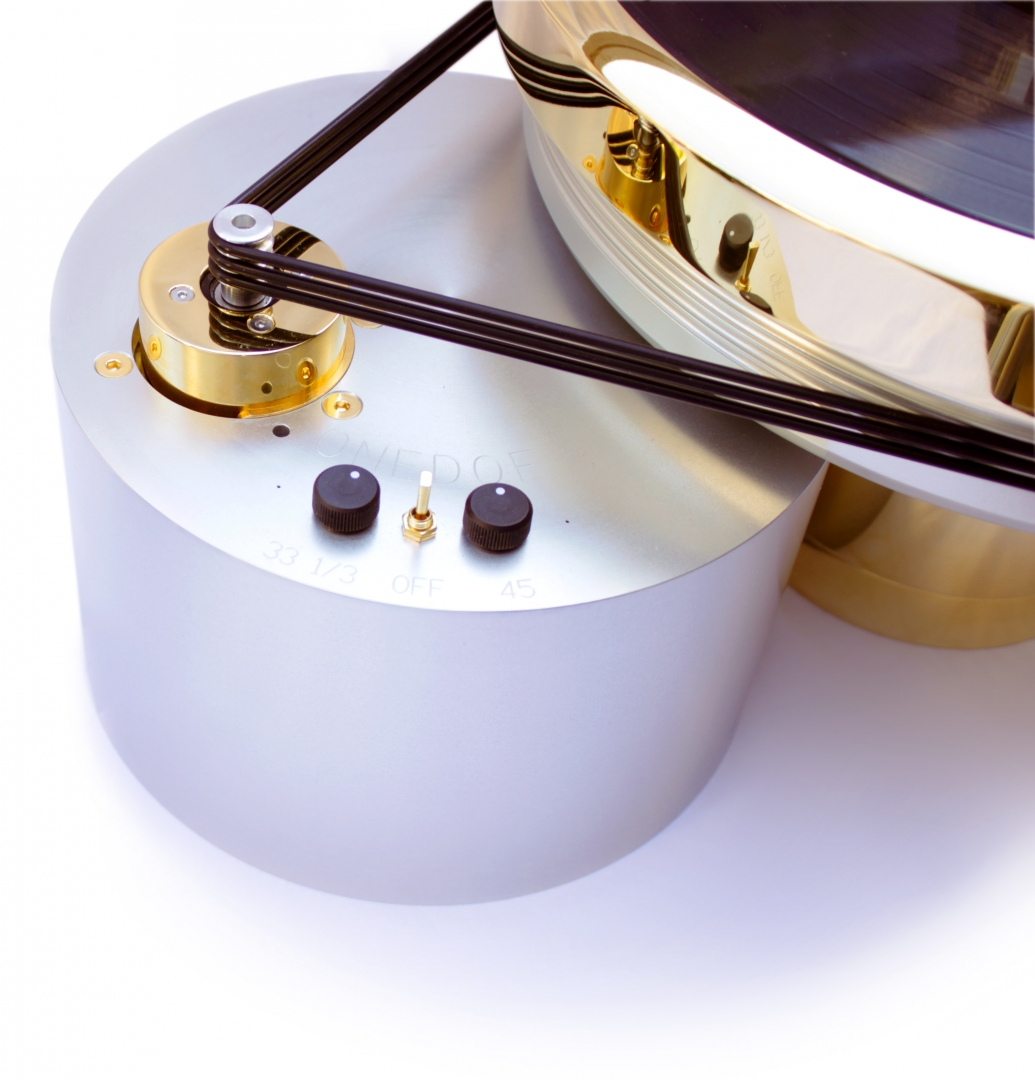 |

ONEDOF™ is a fundamentally reinvented analog vinyl disk turntable.
The turntable features:
· Self-centering in all directions non-resonant platter bearing based on smart fluid technology.
· The innovative bearing removes platter spindle instability, eliminating a never before addressed cause of acoustic distortion.
· Noiseless, noise canceling drive.
· Damped and automatically centered record clamping ring for the highest in the industry allowable volume of music reproduction without distortions.
· Tonearm tower with continuous, smooth yet solid on-the-fly Vertical Tracking Angle adjustment over three inches.
· 70 lb metallic platter spindle with internal viscous liquid damping, clamping rim and center weight. The turntable weight is 120 lb.
· 24 carat gold plating. Aerospace grade metals.
THE ONEDOF STORY: Idea of a perfect, zero tolerance self-centering non-resonant friction free bearing came to Mr. Aleks Bakman in 2000, when he was skiing up the 14265 ft. (4350m) Quandary Peak in Colorado. Research, calculations, and design took evenings and weekends of more than five years. Aleks's day job at that time was developing spacecraft for Lockheed Martin Space Systems. Finally the first manufactured bearing had shown better than expected performance. The trouble was that the science did not stand still all those years. Redesigning bearing based on the latest NASA publications took another year, but the bearing had become orders of magnitude better. Now the runout of the bearing could not be detected. It was the turn of the electric motor drive to be optimized beyond recognition. After that being done in just a couple of years, came the epic battle of ever more damping. Any metallic platter rings like the bells of St. Paul’s Cathedral. Inside the Onedof platter Mr. Bakman placed high tech witch’s brew. Already viscous undisclosed liquid had become infinitely more damping due to enormous surface of the microscopic proprietary solid particles suspended in it. The platter had lost its tongue and became neutrally mute. The size of an unspoiled acoustic n-dimensional sound stage had exploded with the deeper shade of black on the background.
The Bearing |
|
- Microscopic whirling in the conventional platter bearing leads to macroscopic wobbling of the platter. This design problem of all bearings is solved. It is eliminated by the innovative design of self-centering in all directions Onedof™ platter bearing. ONEDOF means "one degree of freedom of motion" - only steady rotation.
- The suspension and the bearing are maintenance free.
- There is no friction, no wear, virtually no heat generated, no thickening or pollution of the oil.
- This bearing will last many generations without service.
Suspension and Damping |
 |
Another first in the history of turntables is a resonance free suspension.
- Suspension is an integral part of the Onedof™ bearing.
- The viscous uncompressible liquid suspends heavy rotating mass.
Pressure is generated by the rotation of the platter. No pumps. - There is no solid load path from the platter to the stand.
- The suspension blocks the distortions coming from the environment.
- The suspension cancels the vibration of the platter/spindle assembly.
- The suspension does not generate its own distortions.
- The suspension provides non-linear damping and stiffness, so there is no condition for the resonance.
- Large sealed chambers inside the platter are filled with a mix of viscous oil and solid particles to damp out the resonances of the platter.
- Around the perimeter of the platter the precious vinyl record is pressed down by a massive damped and automatically centered clamping ring.
The Tonearm Tower |
 |
- The tonearm tower, featuring continuous and smooth on-the-fly VTA adjustment over 3 in., works with any tonearm and cartridge combination. Tonearm has massive support, to prevent resonances. The Onedof ™ turntable can work with four tonearms simultaneously.